

Common Mistakes in Reflective Writing and How to Fix Them
There is a particular kind of page that looks like reflection and isn't. It has the right shape: a scene, a feeling, a lesson, a closing line about how much you have grown. And yet nothing on it could only have been written by you. That is the tell. Reflective writing rarely fails because the writer has nothing to say; it fails at the level of habit — reaching for the phrase that is already there, hiding behind a word wide enough to mean anything, and tying the whole thing up before the thought has had time to arrive.
What follows are the mistakes that show up most often, and each one comes with a repair you can try on a piece you have already written. Keep a draft open while you read. These are easier to recognise in your own work than in anyone else's.
The phrase that was already there
Clichés arrive faster than memory does. Ask someone what a hard week felt like and the first sentence out is usually borrowed: the rollercoaster, the weight off the shoulders, the chapter closing. None of these are lies. They are simply pre-owned — they describe the category of an experience instead of the experience itself.
Common offenders in reflective writing tend to cluster around the same few moves:
- It was a rollercoaster of emotions.
- Everything happens for a reason.
- Little did I know what was coming.
- Words cannot express how I felt.
- I felt a weight lift off my shoulders.
Notice that each one does the same work: it announces a feeling and then steps back from it. The repair is not to hunt for a fancier phrase. It is to go smaller and more physical. Underline the cliché, then write underneath it the detail you would only mention to one person — the object in the room, the thought that was too petty to admit, the thing you did with your hands. I felt a rollercoaster of emotions becomes I read the message three times, then filled the kettle for tea I didn't drink. The second sentence can only belong to one person. That is the whole difference.
The kitchen-table test
Read the sentence aloud as if you were saying it across a table to a friend. Anything you would never actually say out loud — I was on cloud nine, it was a blessing in disguise — is a sign that the sentence is still a placeholder. Leave a gap there and come back to it later if you need to. A blank line is more honest than a borrowed one.
Abstraction as a comfortable hiding place
Growth. Journey. Healing. Resilience. Boundaries. Authenticity. Closure. These words are not wrong, but they are conclusions, and most drafts use them to skip the argument. A paragraph that says I learned a lot about resilience has told the reader the label on the box and handed them an empty box.
The fix is to define the abstraction by evidence. Write the scene that made you reach for the word, then delete the word and keep the scene. If the paragraph still shows what happened, you never needed the label. If it collapses without it, the label was doing all the work and there was nothing underneath.
Watch for clumping, too. Phrases like my journey toward authenticity and healing stack three abstract nouns in a row, which usually means the writer has not yet decided what actually happened. Slow down at that point in the draft. Something in the material is unresolved, and the sentence is covering for it.
One abstract noun per paragraph is a generous allowance. Make it earn its place.
The ending that arrives before the thought
Rushed conclusions are the hardest habit to break because they feel like good writing. The paragraph gathers speed, the lesson appears, the tone turns warm and certain. And that's when I realised that sometimes you have to let go. The reader nods and closes the page with nothing left to do.
Two versions of this show up constantly. The moral ending explains what the experience meant and closes the door. The twist ending reveals that everything was secretly fine, or secretly a lesson, and closes the door slightly faster. Both are attempts to be finished, and finishing too early is what makes reflection feel thin.
Try writing three endings instead of one:
- The moral. The tidy sentence about what you learned. Write it so you can see it clearly.
- The image. The last concrete thing you can see from that day — the light, the sound in the corridor, the plate left on the table.
- The question. The thing you genuinely still don't know: whether you would do it again, what you would have said if you had been braver.
Then choose the one that leaves a little air. In practice that is almost never the moral. A useful test: cut the final paragraph entirely and reread. If the piece gets better, the paragraph was a lid, not a conclusion.
Summary where a scene should be
We argued and I felt upset. This is a report, not a reflection. It records that something happened without letting the reader into it. Reflection needs tension, and tension lives in specifics: the exact sentence that started it, the moment you knew you were being unfair, the detail that contradicts the version of yourself you prefer.
Here is a reliable way in. Find the place in your draft where your account is slightly too flattering, then write the two minutes before it. Where you were reasonable, find the thought that wasn't. Where someone else was difficult, find the thing you did first. You do not have to be harsh with yourself; you only have to be accurate. Readers trust a narrator who is willing to be a little unflattered, and they learn far more from that than from any stated lesson.
Borrowing a voice that isn't yours
Reflective writing attracts ceremony. The vocabulary inflates — utilise, endeavour, profound, a myriad of — and sentences grow three adjectives where one would do. There is also the passive voice used as a hiding place: mistakes were made, it was decided. Someone made them. Someone decided.
Read the paragraph aloud. Every word you would be embarrassed to say in your own kitchen is a word to cut. Keep the plain verb. Let one adjective survive, the accurate one. The voice on the page should be the voice you actually think in, only slower and better organised.
A repair list for your next draft
Work through it in passes rather than all at once, because each pass asks you to look for something different.
- Circle every phrase you have read before. Replace each with a detail you have never written down.
- Underline the abstract nouns. Delete all but one per paragraph, then check whether the scene underneath still stands.
- Find the paragraph that explains. Turn at least half of it into something that happened.
- Cut the last paragraph and read again. Notice whether you miss it.
- Read the whole piece aloud, slowly. Every stumble marks a place where the voice is not yours.
- Leave it for a day, then open it with one question: which sentence would I keep if I could only keep one? Start the next draft from there.
A small practice
Take a page you wrote months ago and choose a single paragraph. Rewrite it under two rules: no abstract nouns, and no sentence longer than twelve words. Nothing else has to change — same events, same people, same ending. Then read the two versions side by side and keep the one that makes you hesitate slightly.
That hesitation is the useful signal. It means you have stopped describing reflection and started doing it, and a reader will feel the difference immediately. The details are what carry the meaning; the lesson is something they will arrive at on their own, a few lines after you stop writing.
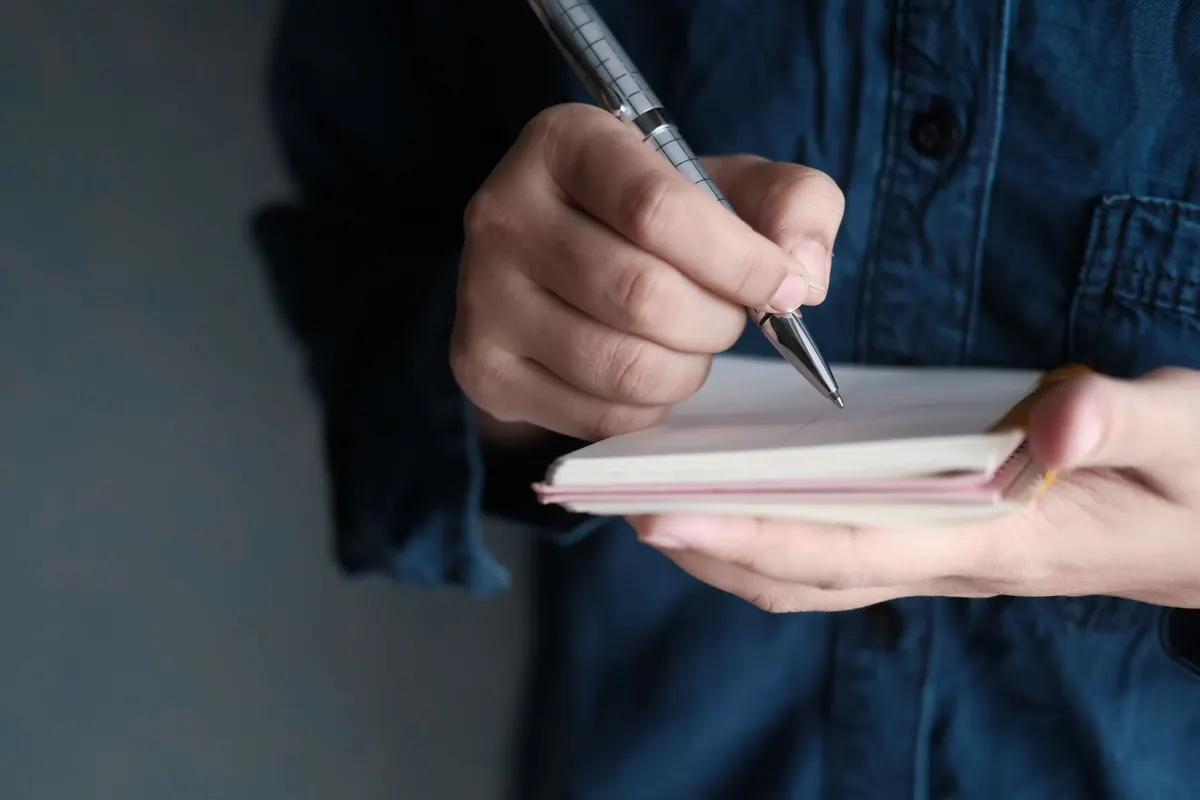
Photo: Towfiqu barbhuiya / Pexels